Physical Simulation
Meshless Helmholtz-Hodge decomposition
Transactions on Visualization and Computer Graphics 16(2): pp. 338-342 (March 2010)
abstract
Abstract
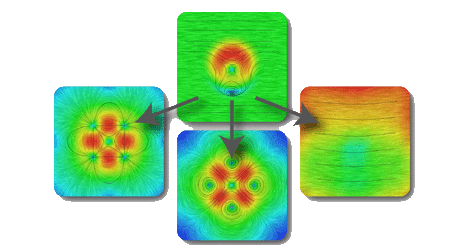
Vector fields analysis traditionally distinguishes conservative (curl-free) from mass preserving (divergence-free) components. The Helmholtz-Hodge decomposition allows separating any vector field into the sum of three uniquely defined components: curl-free, divergence-free and harmonic. This decomposition is usually achieved by using mesh-based methods such as finite differences or finite elements. This work presents a new meshless approach to the Helmholtz-Hodge decomposition for the analysis of 2D discrete vector fields. It embeds into the SPH particle-based framework. The proposed method is efficient and can be applied to extract features from a 2D discrete vector field and to multiphase fluid flow simulation to ensure incompressibility.
downloads
Downloads
cite
BibTeX
@article{sph_hh_tvcg,
  author        = {Fabiano Petronetto and Afonso Paiva and Marcos Lage and Geovan Tavares and Hélio Lopes and Thomas Lewiner},
  title         = {Meshless Helmholtz-Hodge decomposition},
  year          = {2010},
  month         = {march},
  journal       = {Transactions on Visualization and Computer Graphics},
  volume        = {16},
  number        = {2},
  pages         = {338--342},
  publisher     = {IEEE},
  doi           = {10.1109/TVCG.2009.61},
  url           = {https://thomas.lewiner.org/pdfs/sph_hh_tvcg.pdf}
}
related