Discrete Topology
Schnyder woods for higher genus triangulated surfaces, with applications to encoding
Discrete and Computational Geometry 42(3): pp. 489-516 (October 2009)
Selected for publication from the SoCG 2008 conference
abstract
Abstract
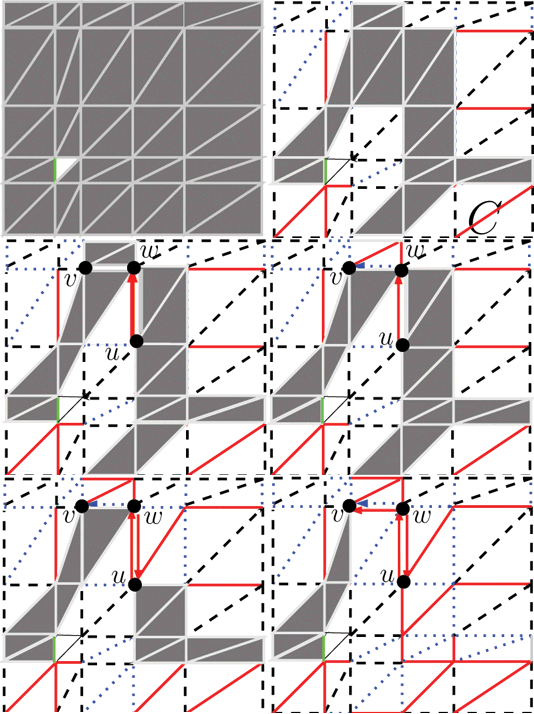
Schnyder woods are a well-known combinatorial structure for plane triangulations, which yields a decomposition into 3 spanning trees. We extend here definitions and algorithms for Schnyder woods to closed orientable surfaces of arbitrary genus. In particular, we describe a method to traverse a triangulation of genus g and compute a so-called g-Schnyder wood on the way. As an application, we give a procedure to encode a triangulation of genus g and n vertices in 4n+O(g log(n)) bits. This matches the worst-case encoding rate of Edgebreaker in positive genus. All the algorithms presented here have execution time O((n+g)g), hence are linear when the genus is fixed.
downloads
Downloads
cite
BibTeX
@article{realizer_dcg,
  author        = {Luca Castelli Aleardi and Eric Fusy and Thomas Lewiner},
  title         = {Schnyder woods for higher genus triangulated surfaces, with applications to encoding},
  year          = {2009},
  month         = {october},
  journal       = {Discrete and Computational Geometry},
  volume        = {42},
  number        = {3},
  pages         = {489--516},
  publisher     = {Springer},
  doi           = {10.1007/s00454-009-9169-z},
  url           = {https://thomas.lewiner.org/pdfs/realizer_dcg.pdf}
}
related